Category: Dailies
Joba the bust?
Just one day before the Yankees flew out to the West Coast for a three-game set at Angels Stadium, YES Network broadcasters David Cone and Ken Singleton had a conversation about a somewhat undervalued pitching statistic while calling a Yankees-Twins game at the Metrodome.
Cone made the point that the earned run average commonly used to measure a pitcher’s effectiveness versus batters can be deceptive in assessing his overall performance unless his unearned average is also factored in over an extended period. If a pitcher shows a tendency to give up unearned runs after a fielder commits errors behind him, it isn’t reflected in his ERA. But, those runs count nonetheless — as do the losses to which they may lead. Cone added that a high number of unearned runs over a season, or a career, may show a flaw in the pitcher’s makeup
Singleton agreed with Cone, adding that as a player with the Baltimore Orioles, he had a good idea which pitchers on his team’s staff would give up runs after a fielding error, and which ones would hang tough, pick up his team, and get out of the inning without letting the opposition score.
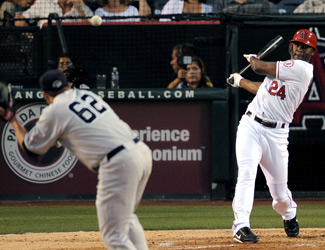 As the Yankees veered toward a 10-6 loss to the Angels on Friday night after their starter Joba Chamberlain blew a four-run lead, Singleton recalled that conversation, mentioning that the 23-year-old righty had the highest unearned run average in the Yankees starting rotation.
Chamberlain’s problems began with a thorny 29-pitch second inning in which he issued a walk, wild pitch and allowed two hits to give up his first run of the game. He’d had trouble putting away batters from the beginning of that frame, when the first Angels hitter at the plate, outfielder Juan Rivera, singled to center after a five-pitch at-bat. Joba then managed to induce a flyball out to first baseman Kendry Morales in two pitches. But he would issue a five-pitch walk to the next batter while Rivera took second on the wild pitch. Gary Matthews would then single and score Rivera after an eight-pitch at-bat. Two batters and nine pitches later, Chamberlain would at last notch his third out of the inning and leave the mound relatively unscathed, having given up only the one earned run.
But, his remaining 3 1/3 innings were a struggle against an Angels lineup that was without its key offensive players, the injured Torii Hunter and Vladimir Guerrero. The box score shows Chamberlain went through a scoreless third inning in 14 pitches, allowing only a single to infield Maicer Itsuris. It does not show that his first recorded out came on a hard-hit liner by Chone Figgins that fortunately wound up in Robinson Cano’s glove. It does not show that his second out was a flyball off the bat of Bobby Abreu that nearly went into the stands for a two-run homer. It does not show that the score could easily have been 4-3, or even 4-4 before Chamberlain left the mound.
It also doesn’t reveal that only an exceptional inning-ending play by Cano saved two runs from scoring in the fourth inning.
Of course, box scores are often deceptive. All pitchers rely on solid fielding and a little luck to make their final lines look better than they otherwise might be. But the good ones capitalize on the defensive plays behind them, the line drives that rocket directly into a fielder’s glove. The good ones know how to win.
In the fourth inning of Friday night’s game, Chamberlain crumbled over the course of throwing 26 pitches. After he surrendered a run on a single to Figgins, who would then steal second, there would be another stolen base behind him, and later a throwing error by Alex Rodriguez that put two men on base with one out.
As Kendry Morales prepared to take the mound, manager Joe Girardi left the dugout to encourage Chamberlain.
“Just get the hitter,” Girardi said. “Let’s make sure we concentrate on the hitter and not get caught up with anything else.”
Chamberlain’s next pitch was a hanging curveball that left the park to tie the score at 5-5. A volley of celebratory home-run fireworks later, Angels designated hitter Mike Napoli doubled off Chamberlain, who’d fallen behind him 2-0 in the count. That ended Chamberlain’s outing as he was replaced by Scranton call-up Mark Melancon and the Yankees’ night continued to unravel.
This is how Chamberlain evaluated his performance after the loss: “I’ve come up against some good ballclubs. There’s really nothing else to say. I threw all four pitches for strikes. They just hit the mistakes. That’s what they’re supposed to do.”
Chamberlain would contend that he made “great” pitches throughout the game, including the one that Figgins hit for a leadoff single in the fifth. “It was my pitch that he hit, and you gotta tip your cap to him,” he said.
And the pitch Morales knocked out to center for his mammoth home run?
“Kendry swung the bat well. It was a curveball for a strike, a little up, but it was something we felt confident in throwing it, and he put a good swing on it.”
We felt confident? Chamberlain’s use of the first-person plural was presumably meant to refer to himself and his battery mate, catcher Jose Molina. But it wasn’t Molina who left that hanger over the plate.
Asked if he thought his pitching in that disastrous fifth was different than it had been in preceding innings, Chamberlain replied in the negative. “Not at all,” he said, noting only that the slider Abreu nearly hit for a homer in the third was also “a little up.” A moment later, he would insist to reporters that he’d pitched well overall. “Other than that we were in and out all day, up and down, so it was good,” he said.
Chamberlain would talk about putting the game behind him, learning from his mistakes, continuing to grow. It is a familiar run of baseball clichés that he has readily used when pressed about his struggles, even as he’s become visibly ruffled by suggestions that his performance this season has been disappointing.
And as to those mistakes — has he learned from them?
Chamberlain has only one win in April, one in May, and two in June. Chamberlain allowed 12 walks and 24 hits over the 22 1/2 innings he pitched in May, averaging four innings and change per game over his starts. Over his six June starts Chamberlain gave up 15 walks and 33 hits while averaging 5.8 innings per game. In July, as his ERA has climbed above 4.00, he’s not yet gotten past the fifth inning in either of his two starts.
More significantly, Chamberlain’s mound appearances have taken on an awful sameness characterized by his falling behind batters to rack up high pitch counts, failing to recover from errors committed behind him, and ultimately leaving games to be decided by the Yankee bullpen while contributing to its depletion.
“At the end of the day, we got the second half to get better,” he said near the conclusion of his post-game interview.
We, again. The Yankees began Friday night tied with the Red Sox for first place in their division. They had gone 7-2 in the month of July for a .778 winning percentage, and were a season-high 17 games over .500.
That’s a team that’s collectively done pretty darned well of late.
Perhaps, then, Chamberlain ought to start using the singular “I” when speaking of his own failures. There is something insufferable about his inability to take responsibility for them.
“This is not a guy that’s been horrible. Going into tonight he had an ERA of around four,” manager Joe Girardi would say in Chamberlain’s defense after the game. Girardi will always take pains to avoid publicly embarrassing his players.
But Chamberlain’s ERA has bee
n a transparent mask for his deficiencies. Simply put, the numbers lie in his case. And lie dramatically.
The equity Chamberlain once gained as a reliever is long since spent with Yankee fans. Gone are the days of Chamberlain throwing at speeds in the high 90 mile-per-hour range. His velocity is now average, his fastballs lack movement, and the speed differential between his fastball and breaking pitches has leveled off to make the latter less effective. For fans, watching him pitch is a nerve-wracking, arduous test of patience. One can only surmise what it must be like for his manager and teammates.
Unfortunately Chien-Ming Wang’s injury, just as he showed signs of a return to his past winning form, has complicated matters for the Yankees. Already short a starter, they cannot now remove Chamberlain from the rotation, even should they be so inclined.
So, what can be done?
For one thing, the Yankee organization, from the front office to his coaches, must hold Chamberlain accountable for his subpar and poor performances. It can only be hoped that Chamberlain’s self-assessments reflect a young ballplayer’s pride and bravado speaking before throngs of reporters and cameras, and not a real and profound blindness to his own shortcomings. If Chamberlain truly believes he’s been getting better, something is disturbingly wrong with his perspective.
This should not be considered an indictment of Joba Chamberlain, but a reasoned appeal to the Yankee organization. They must evaluate what they have with him over the long and short term, and then decide how to proceed moving on. Because there are undeniable signs that Chamberlain is not at all what they once thought they had, and may be rapidly turning into something they cannot live with.
Which is to say, a liability.
Cervelli, anyone?
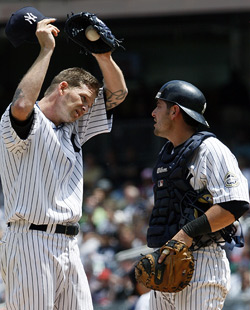 When I say I’m going to miss Francisco Cervelli, it isn’t because I don’t think Jose Molina’s a fine backup catcher. And when I say I already miss Ramiro Pena, it isn’t that I don’t realize Cody Ransom has more pop in his bat than the rookie infielder.
I realize the Yankees have options on Cervelli and Pena that they don’t with the two guys they replaced for a while. I understand that their getting consistent playing time in the Minors is generally better than bench time in the majors.
I also agree with the unwritten rule that says a player shouldn’t lose his job to another guy because of injury — all things being equal, or fairly equal, in terms of their relative production.
Finally, I admire the modest, workmanlike professionalism of Molina, and think the Yankees had a real need for a lefty slugger and versatile utility guy like Eric Hinske, so I won’t raise a stink about Cervelli being sent down to Triple-A Scranton/Wilkes Barre with the reactivation of Molina from the disabled list, just like I didn’t when Pena lost his spot on the active Major League roster with the trade acquisition of Hinske.
But because the Baseball Gods are fickle — and human understanding of how they work tenuous at best — I feel some trepidation now that Cervelli and Pena have exited the stage, at least until the big-club rosters expand in September.
Maybe it’s those traces of my 2006 playoff elimination hangover. I have overlapping playoff elimination hangovers, some of which go back quite a few years. There’s the 1995 horror in Seattle, of course. And then Cleveland in 1997; unlike Mariano Rivera, I can’t put the losses completely behind me. It’s one reason I appreciate his greatness – I don’t think I could be a closer for more than a week or so, even if I found myself in another life and could throw a pitch faster than 50 mph.
I’m too easily haunted by the past.
Again, my ’06 PEH being an example.
A brief refresher: The first half of the Yankees’ 2006 season was marked by a slow start and critical injuries. In late April, the power slugging Gary Sheffield crashed into Toronto Blue Jays first baseman Shea Hillenbrand while attempting to run out a groundball. Sheffield injured his leg and wrist, and the bum wrist would eventually require surgery to repair a torn tendon and ligament and sideline him for almost the entire season. Ouch.
That hurt in more ways than one. Especially from my perspective, because Hillenbrand was a former member of the Red Sox.
Just over a week after Sheffield went on the DL, the Yanks’ problems were gravely compounded when Hideki Matsui messed up his wrist trying to make a sliding catch in shallow left field. In his case, there were broken bones. Ouch-ouch. And yet again, incidentally, the whole thing was tied to the Red Sox, who the Yanks happened to be playing when their No. 2 batter, Mark Loretta, hit his miserable blooper out to left to end Godzilla’s monster 518-consecutive-game streak.
There were a number of other injuries that year. I won’t mention the starting pitcher with the bruised backside by name because saying, thinking or typing it still puts me in a surly mood. But even as things looked their bleakest, the team’s personality began taking on a kind of mojo-moxie magic. Robinson Cano had an incredible second season, Melky Cabrera a very good first full year in the Majors, and replacement/utility guys like Andy Phillips, Bubba Crosby, Miguel Cairo and a few others really fired up the team. Meanwhile, Bernie Williams, who was supposed to see very limited playing time from the bench, wound up in the outfield a whole lot more than anticipated, and did far better than the Yankee front office seemed to expect, being that they hadn’t asked for the opinion of Bernie fans beforehand.
Then came the midseason trade for Bobby Abreu and the late Cory Lidle, and Boston Massacre II, and the Yanks winning the AL East pennant to charge into the playoffs.
What also happened along the way was Matsui returning around mid-September, and Sheffield later in the month — in Sheffield’s case just in time for former Yankees manager Joe Torre to try and squeeze him into the postseason lineup.
In October, the Yanks hit a wall. Screech, crash. There were many contributing factors to their prompt division series elimination at the hands of the Detroit Tigers and their suddenly maniacal pitching ace Kenny Rogers. But I’ll always feel that some of the team’s do-or-die spark left when Melky moved aside to make room for Matsui, and Sheffield’s return pushed Phillips, who didn’t hit much but had a decent glove, out of the picture.
Now, I’m not comparing that baseball season to the current one or suggesting the Yanks’ recent player moves will have similar ramifications. It’s a whole different set of circumstances right now — apples and oranges, in a way, since we’re presently talking about utility players rather than starters.
 But Pena is a vastly superior fielder to Ransom, and he’s quick as quicksilver, and had a penchant for timely hitting in his brief stint with the Yankees. And Cervelli was defensively not all that inferior to Molina, and could run, steal bases and had a determination, intelligence and special way working with pitchers that compensated for his lack of experience behind the plate.
And both those guys had that mojo-moxie-magic-do-or-die-spark thing going.
Now that they’re gone, I wish them well refining their skills, hope to see them in September, and believe the team will do fine in their absence.
Still, what can I tell you?
When you’re a PEH sufferer, you can’t help but worry.
Reggie uncut
Not so long ago, his bat was the thunder at the heart of the Yankee lineup. In a major league career that spanned two decades, he played in ten postseasons, winning three World Series rings with the Oakland Athletics and two more with the New York Yankees. He was the American League and World Series MVP in 1973, and the 1977 World Series MVP when the Yankees defeated the Dodgers in six games. In the final game that series at Yankee Stadium, on October 18, 1977, he belted three homers on three pitches and three swings in three consecutive plate appearances to propel his team to the championship and earn the famous nickname Mr. October.
When Reginald Martinez Jackson hit those three homers, he became only the second a player in history to do that in a single Series game. It’s probably no coincidence that the guy who preceded him holding that record also had a nickname that stuck: The Babe.
And, oh yes, Reggie Jackson was no stranger to controversy.
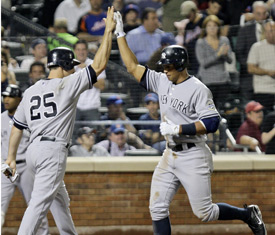 In Friday’s night 9-1 Yankee win over the Mets at Citi Field, Alex Rodriguez hit his 564th Major League homer to move past Reggie into 11th place on the all-time career home run list. When Jackson retired in 1987 he’d ranked sixth behind Hank Aaron, Babe Ruth, Willie Mays, Frank Robinson and Harmon Killebrew. Barry Bonds, Ken Griffey Jr., Sammy Sosa, Mark McGwire, Rafael Palmeiro — and now Rodriguez — would later surpass his record. But for Jackson A-Rod’s upcoming milestone had meant something special. A fellow member of the Yankee organization and friend of Rodriguez, Jackson had traveled cross-country from his West Coast home to hopefully be present when it was hit.
As the media crowded Rodriguez’s locker in the visiting clubhouse for his postgame comments, it was announced that Reggie would be taking questions in the corridor outside. A contingent of sportswriters broke off from the larger gathering to talk to him–and listen as Jackson stood in his trademark ballcap, fielding hugs from Andy Pettitte, waving to other players and clubhouse people, and reflecting on Rodriguez’s accomplishment and other subjects.
Gradually some of the writers filed off to listen to CC Sabathia’s press conference. I stuck around along with a couple of other guys. Though his voice was subdued, I found Reggie as brashly engaging, playful, and appreciative of an audience as ever.
Here’s some pure, unfiltered Reggie, with cuts only to eliminate repetition or because the hubbub in the corridor made some of his remarks unintelligible on playback.
On how A-Rod’s admission that he used performance enhancing drugs will impact his legacy:
“The negativity that surrounds the steroids is certainly not something that I carry over to him. I do appreciate the fact that he admitted his mistakes. So from here we move forward. Judgment on him will be passed within the next seven and a half years. I don’t vote {on Rodriguez’s eventual candidacy for the Hall of Fame} If he doesn’t make it in the first fifteen years on the ballot, I get a chance. But this guy’s probably gonna wind up with seven or eight hundred home runs. I wanna enjoy the night tonight and watch my friend hit number five-sixty-four. And (grinning) maybe you’ll all drop my name in the paper when you’re all going by.”
On whether it is bittersweet watching someone pass his career home run record:
“Not really. You know, you get used to it, really. There’s been five or six {players} in the last four, five years. I think when you see some of the great names fall, you get sad. Like I was watching the game the other night with Willie Mays. I’m on the phone, Willie’s on the phone for about forty five minutes. We were talking about Alex. He was in a little slump there in Florida and Atlanta, and I was watching the game with Willie. And we talked about homer uns, we talked about steroids, and stuff like that. But today, I think, is a day for me to come and tip my cap, be a gentleman, be a fan. Really, I get a chance up close and personal to say ‘Nice going, congratulations to you and keep hitting home runs for the Yankees, and I’m here rooting for you.'”
On his own legacy:
“I think that I’ve been in such a wonderful position for the last few years, with the places I go . . . I was just at a Corvette show in Illinois, and people walk up to you — eight, ten, twelve, fourteen years old — a and ask for autographs, even though they weren’t born yet when I retired. And so, I have a lot of friends in the game, and the game has been very good to me. And so thinking about it, re-experiencing it, sharing it . . . I enjoy it. And I appreciate spending time with people and the fans.”
On why Derek Jeter (with whom Reggie watched last night’s game in the visiting clubhouse) is his favorite player:
“I’ve known him the longest. I’m kinda like a big brother to him . . . He’s got all the ingredients, man. And he’s my friend. So I’m certainly prejudiced.
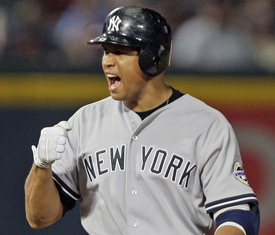 On his relationship with A-Rod:
“Alex Rodriguez is my friend, so I’m prejudiced, and I don’t have a lot of negatives to say. If I have negatives to say, I certainly can say them to Alex, I know him that well. I certainly can get on his butt sometimes if I see some things going on on the field that I don’t approve of. But that’s man to man. That’s pro to pro. “
On Rodriguez as a player:
“Alex Rodriguez plays as hard as any player I’ve ever seen. He prepares as hard, and works as hard, as any player I’ve ever seen around the game. You’ve got to tip your cap. I always say, they used to say about me, ‘Reggie Jackson, love him or hate him, you cannot ignore him.’ Alex Rodriguez goes to the post every day unless he’s in the hospital. And that you’ve got to tip your cap to. You just have to, with all the adversity that he’s gone through, and all the tough times he’s had, he goes out there. And he’s had some days and some moments and some adversity that have been really tough. So he’s vulnerable. A big target. But you’ve got to tip your cap. . . . I look forward to the day that he has success to help this club win a championship. Until then, we won’t let him up. We’ll keep the thumb on him, the spotlight’ll stay on him, and the critiques will be there till we win. So, as my friend, I would like to see him win . . . I’m a Yankee fan, and I’m proud of it. The places I go, and everywhere I go, I’m proud of it.”
On why he traveled to see Rodriguez top his career home run record:
“I’m more than just an ex-player and a Yankee. I’m part of this organization. I’m part of the franchise. From the Steinbrenner family down to the clubhouse people, I am part of it. So being a Yankee, the right thing to do is to be here. And I wanted to be here. I’m not here because it’s the right thing to be here. I have a sister that’s very ill, I could be home. I have a child that’s deciding on college. But I needed to be here. I’m part of this ballclub. I talked to the owners, I’ve talked to the president of this team, and I’ve talked to the manager, so this is important to me. “
Addressing the press in the clubhouse even as Reggie spoke outside its doors, Rodriguez made it clear Jackson’s prese
nce was also important to him, calling Reggie “a close friend and mentor” and “an American icon.”
For this writer, having a chance to hear him share some thoughts was a gas, plain and simple.
Hope reading them been fun for all of you.
A Large, Unsettling Question
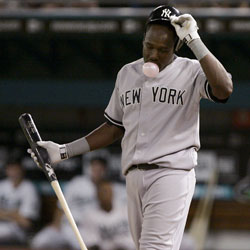
If you are a baseball fan, and you woke up feeling good about your team today, that team probably isn’t the New York Yankees.
Entering the twelve-game stretch that began when they were swept by the Boston Red Sox at Fenway on June 9-11, the Yankees were 34-24, ten games over .500 and tied with the Sox for first place in the AL East. They had a game-and-a-half lead over Toronto, and a six game lead over the Tampa Bay Rays.
Today they are 38-31, seven games over .500, four games behind the first place Red Sox, hold a one game lead for second place over the Toronto Blue Jays, and are only two games ahead of the fourth place Tampa Bay Rays.
They have lost three out of the last four series, and would have lost all of them if it hadn’t been for Mets second baseman Luis Castillo dropping a pop flyball that would have closed out Game One of the Subway Series for his team had it landed in his glove. Two of those series losses have been against National League East teams with losing records, one of them the worst in baseball. They also come as the Red Sox and Tampa Bay are busy beating up on their NL counterparts.
Despite an elite roster bolstered in the offseason by the costly acquisitions of CC Sabathia, A.J. Burnett, Mark Teixeira and currently dormant reliever Damaso Marte, they are doing just slightly better than the 40-35 record they held last season at this time, remain only one game closer to the Red Sox in the standings, and are exactly the same number of games behind them in the loss column.
As of right now, this makes the 2009 New York Yankees a tremendous, expensive disappointment.
If you are a Yankee fan this morning, and you watched our team lose the rubber game of last weekend’s set against the Florida Marlins on Sunday, you might recall hearing former Yankee, and current YES broadcaster, Paul O’Neill, comment that this was an extremely important series for the Florida franchise. As young team, he said, they needed to prove they could play against the Yankees.
But it was arguably a far more important game for the Yankees, who suffered yet another series loss to a team that had no business beating them, and have gone south in more ways than one heading into Atlanta for an interleague series with the Braves.
If you are a Yankee fan this morning, it leaves you wondering a few things.
After stalwart long reliever Alfredo Aceves had thrown almost three innings in scoreless relief of CC Sabathia, who left the game in the second inning with a sore left bicep, manager Joe Girardi pulled him from the game at the bottom of the fifth, replacing him with the unreliable Brett Tomko. At the time, the Yanks held a 3-1 lead.
Aceves currently boasts a sparkling 2.32 ERA and had thrown 43 pitches before leaving the mound. His final, hitless inning of work was his most economical; he’d needed only 9 pitches to get through it. Prior to Sunday’s game, he had last seen action on June 18th in a scoreless nine-pitch outing against the Washington Nationals. The day before, June 17th, he had pitched a scoreless 2/3 of an inning against the Nats, dispatching them with only five pitches.
Tomko’s ERA for the season stands at 7.20. With the Yanks leading the Nationals 5-1 in the series opener, he threw a scoreless ninth inning to preserve the victory, while Mariano Rivera tossed in the bullpen, ready to close out the game if he ran into trouble. His previous appearance–on June 12 against the Mets–didn’t go as smoothly, as he surrendered 4 runs on three hits and two walks in a horrific 2/3 of an inning. Before that, he’d given up a run to the Red Sox on two hits and a couple of walks on June 9th, when he threw a total of 47 pitches in 2 1/3 innings of relief.
The Marlins scored 3 runs against him in 2 innings to tie the game. Two of their hits were homeruns. Tomko would leave it to fellow relievers Phil Coke and David Robertson to give up the lead, with the assistance of a throwing error from Melky Cabrera.
But let’s get back to Aceves a moment. A converted starter, he threw a season-high 70 pitches against the Red Sox on May 4, 50 pitches against Baltimore on May 21, and has since had several outings when he threw over 30 pitches.
On Sunday, with the Yanks needing a series victory before an off day on which Aceves would be guaranteed rest, his manager’s decision to pull him is at the very least problematic. It appears that instead of considering how fluidly Aceves was throwing the ball, Girardi opted to be cautious with his pitch count. The result was a Yankee loss.
Recently, a reader of this column asked my assessment of Joe Girardi’s performance as the Yankees’ manager. I told him that I thought it would take a full 2009 season before I could fairly evaluate it.
I still believe that. But if Girardi has shown one serious and noticeably recurring managerial flaw, it is a seeming tendency to have his eyes in his notebook when keeping his head in the flow of the game would better serve the team’s cause. It is a negative that has proven costly on more than a single occasion.
The bad little things I detailed in a previous entry–errors, base running gaffes, and walks to opposing batters–have continued to hurt the Yanks since they lost their winning ways in Boston. Their bats have been sluggish, their pitching spotty, and their overall play lackluster at best.
How much of this falls on Joe Girardi is still an open question, and will remain so for a while.
But on a grey Monday day in 2009 in which the Yankee record and position in the standings is uncomfortably similar to where they were last year–Girardi’s first season as manager, and the first in 13 years that did not see the team make the playoffs–there is no doubt that question has begun to take a very large, unsettling shape.
The Fix
 Preisler@jeromepreisler.com
It would be tough to pin the Yankees’ home series loss to the Washington Nationals, who are mostly known for being MLB’s current answer to the Bad News Bears, on any particular member of the team. Basically they played lousy in general.
If you watched that series, though, and then consider that the Yanks really should have lost two out of three home games to a depleted Mets squad last weekend, and were swept by the Boston Red Sox at Fenway before that — a stretch of nine games during which they’ve stumbled from being one game up on the Sox to three behind them for the AL East division lead — it’s hard not to think that the team needs some fixing.
I’ve been trying to figure out what the fix or fixes might be. And the more I think about it, the more I keep coming back to the deficiencies in right field represented by Nick Swisher, and the spot in the starting rotation occupied by Joba Chamberlain.
Of course, Swisher isn’t responsible for the team’s collective offensive slump. I think that has more to do with Alex Rodriguez not hitting right now than anything. His bat is supposed to be the major noisemaker in the middle of their batting order. When it is silent, the aggregate thunder in Yankee bats goes from a loud roar to isolated rumbles.
Rodriguez has a long track record as one of the most prolific run producers in baseball. You can’t point to age or general physical condition as reasons for his struggles. But he is recovering from serious hip surgery and has played every game since his hurried return. Based on what we’ve seen of him, it’s reasonable to think that with some rest, and recovery time, he’ll round into form.
Or at any rate, he’d better for the sake of his team. He isn’t going anywhere.
Likewise based on track record, however, Swisher is a problem that won’t go away until he does, at least as an everyday player. In a sense it isn’t his fault. With the acquisition of Mark Teixeira, he was supposed to be half of a right field platoon that included Xavier Nady. But Nady got injured, and remains injured, and that has left Swisher a regular starting member of the lineup whose historical weaknesses have become increasingly apparent.
His career numbers aren’t the worst you’ll ever see, but they aren’t good. In 2004, his first year in the Majors, he hit .250. The next year he averaged .236. The next year he hit .254. His best BA was .262 in 2007. His worst was .219 in 2008. He’s now batting .244, a career average.
Yes, I know about the walks. The pitches taken. The slugging and on-base percentages. I’ve read all sorts of numbers.
In fact, I was reading this analysis of Swisher by a hardcore Sabermetrics guy named Peter Bendix. It was written in June 2008 when Swisher was with the Chicago White Sox. A year ago, Bendix wrote how Swisher’s failure to deliver was basically just bad luck. Bendix’s calculations indicated a sharp upturn in his performance was in the offing.
Wrote Bendix of last year’s Nick: “To begin with, Swisher has been very unlucky on balls in play. His 22.5% line-drive percentage produces an expected BABIP of .345. However, his actual BABIP is a miserable .244. If we adjust his batting line to account for the hits he should have, his line becomes .271/.371/.359.”
I looked up the meaning of BAPIP last night, not being familiar with the statistic. A stat-head website called the Hardball Times defines it as Batting Average on Balls in Play, “a measure of the number of batted balls that safely fall in for a hit (not including home runs). The exact formula we use is (H-HR)/(AB-K-HR+SF) This is similar to DER, but from the batter’s perspective.”
I didn’t look up DER. I haven’t checked Swisher’s VORP or PECOTA or any of that stuff. I don’t mean to sound disparaging of the numbers game. Bill James has certainly helped the Boston Red Sox find players who can hit the ball well at their park.
But I have to go with my observational and analytical strengths. For better or worse, I rely on what I see with my eyes and more basic statistics. And when I see Swisher play, I see a guy who plays with a lot of energy, but too often allows that energy to drive him when it his job to harness it. He runs the bases recklessly. He seems to be largely unaware of cutoff men. In clutch situations, he tends to swing for the fences when he simply needs to get on base.
And he’s hitting .244.
I like Swisher on the bench. I’ll take his hustle and energy in small doses and think there are situations when he can be useful to the team.
But the Yanks need to figure out what they are going to get out of Nady this season. My guess is that their expectations are minimal. If that’s the case, they need another solution to the right field problem.
That’s the Swisher part. Chamberlain is next.
I’m weary of the Joba fight. Those who lean toward numbers guys will point to his 3.89 ERA and argue that five innings of that every fifth day is preferable to one or two innings of relief several times a week.
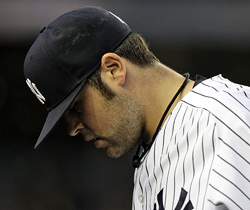 My response is that watching Joba pitch as a starter has become excruciating. He gets into deep counts, he walks batters, he allows droves of them on base,and he depletes the bullpen by failing to give length. He puts his defense on its heels and gives teams like the Washington Nationals the sense that they have a fighting chance.
Opposing teams don’t fear Chamberlain right now, nor should they. Where is his power fastball? His slider? His velocity is now fairly average. It largely has been for a while. The lightning in his fingertips has become erratic, and it’s anyone’s guess whether it will return with any constancy.
Chamberlain has no proven track record as a starting pitcher. Chien-Ming Wang does. Yet Wang is given ultimatums while the Yankee hierarchy continues to disregard Chamberlain’s falling effectiveness and send him out to pitch as a member of the rotation.
Meanwhile, Wang continues to improve and make a case that he should remain in the rotation. And Phil Hughes continues to throw multiple innings of relief with snap and efficiency that suggest he warrants another shot at starting.
If Wang looks good after another start or two, Chamberlain should go to the bullpen. The time when innings restrictions will put him there is approaching anyway, so why wait? Maybe he’ll regain his lightning as a reliever. Maybe next season, with some work, he will become the winning starter the Yankees envision.
Right now the Yankees should be looking to win in 2009 and think about giving Hughes his shot.
We can go by the numbers (assuming they’re being interpreted without skew). Or we can use them wisely to inform what we see. I’d suggest the latter.
A lot of us can follow recipes, but that doesn’t make us master chefs.
Working class players
 Preisler@jeromepreisler.com
During Tuesday night’s broadcast of the Washington Nationals-Yankees series opener at the Stadium, there was an illuminating conversation between Yankees play-by-play man Michael Kay and his on-air partner, John Flaherty.
Why, Kay wondered aloud, would a batter on a non-contending team like that Nats do something like sacrifice himself with a grounder to first base or a bunt to move a runner over? While Kay understood this is the right way to play the game, he was approaching the question from a practical and individualistic angle — if the team isn’t seriously in the race for a championship, what does the player have to gain in terms of his own career? In the final box score it would just look like he’s made an out and lower his batting average.
Flaherty’s response was interesting. The batter, he said, should be motivated to sacrifice in that situation because it’s his job. He might be playing for a contract. He might be playing just to stay in the big leagues. Maybe his manager will notice his effort on behalf of the team. If not, maybe some other manager. You do what you’re supposed to and hope for the best. For Flaherty, the hardnosed former catcher, it was that basic.
The exchange launched me into thinking about something, which in got me thinking about several other things.
The first thing was an e-mail I’d gotten from a longtime reader in reaction to my previous column. She’s a very private person, so I won’t name her, but I hope she won’t mind my sharing an excerpt here:
I love baseball. I love sports in general, but I really love baseball. I love how it seems to represent all of life’s struggles, where you fail more often than you succeed, and no matter what happens in one game, there’s another one tomorrow, where the fight is fresh and the struggle never ends. Through these players we get to live vicariously, given these rules between those lines and we get to laugh and cry for the duration of the game, escaping our real lives, where nothing is for certain and where it is never clear who is the winner or the loser. I truly appreciate those players who seem to see the bigger picture in all the little things they do and carry themselves with integrity and dignity, until the very end of the last game; because no matter who we are and what we do, we should carry ourselves with integrity and dignity.
After turning in for the night, I reflected on her beautifully eloquent words, and then began musing about some people I know, and the unsung dignity and integrity with which they I’ve lived, never knowing or considering what the net gain would be.
In our New England town, there’s a woman whose first marriage ended in a divorce she hadn’t sought. A mother of two, she has an autistic son, and the stresses of her marriage left her caring for her children alone. Entering a tough job market to support them, she found employment as a postal clerk. She would eventually remarry a good man, only to see him lose his life in an automobile accident. It is only a wrinkle of fate that prevented her from being in the car with him.
Her workday begins at four in the morning. She lives out on an island known for its lobstering, and the drive to work is long and treacherous in the frozen winter darkness. But she is a bright, smiling presence at the post office whose diligence, humor and optimism makes it a pleasure to walk in there.
Her son is now a highly functional teenager living in a group home that she and the families of other autistic children helped establish. It is a stone’s throw from her door and he loves it. She actively transitioned him into his new living situation and is constant with her time and love even as she continues working at the post office — and putting her other child, a daughter, through college.
No matter who we are and what we do, we should carry ourselves with integrity and dignity.
Last night, I thought about that woman in Maine. And then I thought about my father too.
In Rumania where he was born, his family was large and very poor. They lived in a rural area and grew most of their own food. After the Nazis invaded in 1940 they were carried by truck to the Jewish ghetto and then loaded into cattle cars bound for the concentration camps. My father always remembers his cat following him for miles over the mountain roads until one of the Nazi troopers shot it dead.
At Buchenwald concentration camp in Germany, my father’s family was almost entirely exterminated in the gas chambers. He was strong enough to be put to work as a slave, and survived eating gruel and whatever weeds and grass and insects he could pick from the ground. Eventually he was trucked off to Mittelbau-Dora in Nordhausen, Germany as part of the slave labor force in the nearby subterranean V-2 rocket complex. When the workers would die of weakness, disease and starvation, their bodies were carried into tunnels and left there. By the thousands.
Powerfully built but short, my father was considered the perfect size for installing components in the nosecones of the rockets. The Germans would boast to him at gunpoint that these weapons, the world’s first ballistic missiles, would be the downfall of England. Inside the nosecones, he would tear out wires by the handful. He must have done it hundreds of times. If he’d been caught once he would have been tortured and killed.
The V-2 rockets never worked the way they were supposed to. Their guidance systems didn’t allow them to hit their targets with accuracy. These guidance systems were in their nosecones.
After the liberation my father eventually came to America. He found a place to live, learned the language and worked for decades in a garment factory in Queens, New York. In the summer the factory was so hot the sweat would drench through people’s clothes as they toiled to do piecework at their industrial sewing machines. At night, when I was a boy, he would leave the factory at night and earn extra money selling whatever he could from the trunk of his car. He never complained.
While visiting my parents at their Brooklyn apartment last winter, I gave my mother a talking Donald Trump doll. My mother likes Donald Trump. Push a button in its back, and the doll, like the real-life Donald, has plenty to say. One of the things it says is, “Always love what you do.”
I was at the dinner table fiddling with the new Donald doll when I heard it make that statement.
Always love what you do.
I turned to my father, thinking of his years in the sweatshop.
“I can’t stand when people say that,” I told him. “Some people do what they have to whether they like it or not. Look at you … working in that factory all those years.”
My father surprised me with his answer. “I loved my job,” he said simply. “It was an honest living.”
I’d never realized he felt that way. All these years, and I’d never known.
No matter who we are and what we do, we should carry ourselves with integrity and dignity.
Amazing, isn’t it, that so many deep thoughts should be prompted by a baseball game? No less one involving the Washington Nationals, the team with the worst record in the sport.
Or maybe it isn’t amazing at all. Maybe it’s because it was the Nats that all this came to mind.
That Washington batter Kay and Flaherty was discussing … he tried to move the runner over. Just hours later, I can’t remember which batter it was, or even if he succeeded. I fault myself for that. I wish I’d been paying closer attention.
There’
s always a lesson to be learned.
For Hye Sun Canning
Yahoo! This is your celebration!
 Preisler@jeromepreisler.com
Over this weekend’s Yankee Stadium half of the 2009 Subway Series, plenty of media grist was derived from the verbal — and at one point almost physical — scrap between Yankees’ reliever Brian Bruney, and Mets closer Frankie “K-Rod” Rodriguez. Most baseball fans are doubtless familiar with the whole thing, so I’ll just recap briefly.
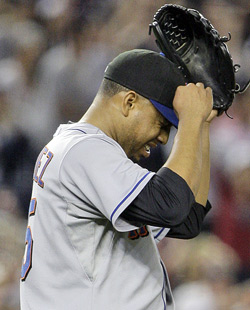
A moment before the series opener ended with an improbable Yankees win when Mets second baseman Luis Castillo dropped an easy pop fly, Rodriguez, who’d induced the pop-up, was apparently primed to launch into his familiar mound celebration: shouting at the top of his lungs, jabbing his fingers at the sky, thumping his chest, and sometimes adding a little James Brown-ish flourish — a one-legged spin that finishes with him dramatically sinking down onto one knee. But when Castillo messed up the basic little league play, Rodriguez instead wound up holding his head with both hands in astonished dismay.
Asked about the game’s wild climax Friday night while completing a rehab stint with the Yankees’ Double-A Trenton Thunder, Bruney remarked that, “It couldn’t happen to a better guy on the mound, either. He’s got a tired act.”
“I just don’t like watching the guy (K-Rod) pitch,” he would go on to say. “I think it’s embarrassing.”
When Bruney’s comments were relayed to Rodriguez, he irately responded by saying that the Yankees’ righty “better keep his mouth shut and do his job, not worry about somebody else.” He also claimed, “I don’t even know who the guy is. I’m not going to waste my time with that guy.”
But during Sunday’s pregame warm-ups in the outfield, Rodriguez seemed to know exactly who Bruney was when he stormed up to him pointing his finger and shouting some heated words. The confrontation might have come to blows if not for Mets pitcher Mike Pelfrey, the Yankees’ Jose Veras, and a few other players and coaches who fortunately stepped in to separate the two.
That apparently ended the whole business except for a high volume of media noise about it, most of which hasn’t so much debated the merits of Bruney’s remarks, but questioned whether he should have publicly made them in the first place.
At his locker after Sunday’s game, Bruney in essence conceded it was a mistake. And it probably was. Once they’re relayed to the criticized party via the press (as they always are), shots of the sort Bruney aimed at a fellow player usually lead to nothing but fan and media rubbernecking. Nothing beats a good sideshow in this world.
Admittedly, though, my first reaction on hearing what Bruney said was a “Go Guy!” fist pump of my own at the TV screen. Like many players and fans, I find Rodriguez’s routine an annoyance. In fact, I wish the grandstanding that’s infected all of professional sports like a stubborn diaper rash would go away. If I want that kind of stuff, I can watch Wrestlemania.
A few years after it first showed up in the NFL via the Mark Gastineau dance, things got so bad I found watching the games tough. I couldn’t stand Gastineau.
When I met him in person much later on, my reaction was very different. I used to occasionally hang at a bar called Jimmy’s Corner on Times Square, which was owned by a fight trainer who also had a boxing gym in the area. Gastineau, who worked out at the gym during his boxing career in the ’90’s, was a fairly frequent visitor to Jimmy’s, as were many boxing personalities. Gastineau was always polite and low-key. I found him very likeable. Once, I recall him helping the barkeep’s wife mop a spill off the floor on a busy night. It was hard to connect that guy with the showboat I’d seen on the tube. I was always tempted to ask why he’d chosen to be a clown on the field — but he’s a lot bigger than I am.
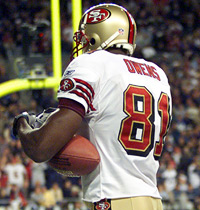 Anyway, the sack dances were small potatoes compared to what would follow. In 2002, as I recall, Terrell Owens, then with the San Francisco 49ers, pulled a Sharpie pen from his sock after scoring a touchdown, signed the ball, and handed it off to his financial planner in the stands. But the capper for me came the next year in a game between the New Orleans Saints and New York Giants, when New Orleans receiver Joe Horn pulled a cellphone he’d tucked under the padding of a goalpost and — he said — made a call to his mom on catching a touchdown pass.
I’m not big on so-called “excessive celebration” rules. I think they open the door to penalties based on very subjective interpretations of a player’s actions. But I was glad with the NFL installed just that kind of rule. It made it easier for me to watch pro football.
NBA basketball’s another story. For me, it’s become unviewable. I grew up a huge Knicks fan rooting for old school players like Walt Frazier, Willis Reed, and Dave DeBusschere. They played hard and never showed up their opponents.
I had no problem with Michael Jordan decades later. He was more demonstrative than the old guard players, sure. But when he’d jump up in the air and pump his fist, it was an honest display of emotion.
For a while I liked the New Jersey Nets. This was during the four or five years when Jason Kidd reenergized the team and took them to the finals in 2002 and 2003. Kidd and his teammates reminded me of the old Knicks. Kenyon Martin sometimes got a bit carried away but I felt his passion on the court was genuine.
I didn’t like it after Martin was traded away, and Vince Carter came along, and started doing his motorcycle-revving bit when he scored. The team never went to the finals with Carter. I don’t know what he was revving about.
Alonzo Mourning was another player whose premeditated outbursts got me. Alonzo’s stunt was to make a muscle like Popeye after a big basket or block. Spontaneous? Right.
And the beat goes on in the NBA. The latest irritant for me was the so-called Hannibal Lecter grimace that Kobe Bryant affected throughout this year’s playoffs. Kobe’s a great player, maybe the greatest active player in the league. He’s won multiple championships. But he never made that puss in his previous postseason runs. Why now all of a sudden?
Maybe I’m wrong, but I believe that people don’t start mugging like that out of the blue. I’ve been in many high pressure situations over the years. My facial expressions have stayed the same. Look at old Super Eight movies of me from when I was eight or nine years old, there’s a recognizable consistency. Even my happy dances are the same as when I was a kid. At no point in my life have I started making cannibal faces or anything.
In pro sports, it seems every other athlete has a shtick. I hate it most in baseball because I love baseball more than any other sport by leaps and bounds. The Barry Bonds school of styling is awful enough — note to Robinson Cano — but it really irked me when Manny Ramirez started wagging his fingers at pitchers off whom he’d hit homeruns.
After a tight save, the Red Sox’s Jonathan Papelbon usually gestures in a way that isn’t fit for family consumption. When it’s not so tight, he just throws out a “*%*$* yeah!” without bothering to cover his mouth with his glove. He knows the cameras are on him. He knows kids are watching him curse. Don’t think he doesn’t leave the glove down on purpose.
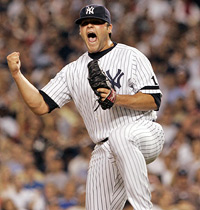 In his first seasons with the Yankees, Joba Chamberlain’s fist pumping got over the top after a while. I believe the gesture to be authentic — heck, his dad does it — but he needed to rein it in some, and he did to his credit. Not so for all pitchers. There’s lot of dancing, yelling and posing to be seen on mounds throughout baseball nowadays.
Maybe these guys need to be taught their lessons. Say a pitcher’s sent to Dr. James Andrews out in Birmingham for an MRI on his shoulder, and Andrews starts jumping up and down, gyrating his hips, and fist-pumping when he locates the source of the guy’s pain on the scan: “A tear! A tear! I found it, yeeeeaiiiiiiioow Mama!!”
You ask me, Frankie Rodriguez wouldn’t be too appreciative of that.
I don’t want to make a big deal out of all this. But like Bruney, I find it all tiresome and unsportsmanlike. So how about managers and coaches ask players to please limit the contrived theatrics? Would it really hurt?
Of course, if that doesn’t happen, the best way to put an end to it is always to simply beat the showboats. As we saw with Frankie, that’s when their hands go from pointing at the sky to their caps.
Bad Little Things
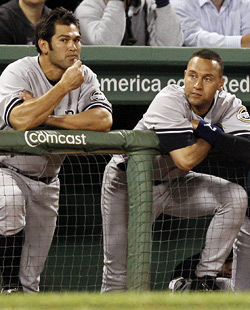 In the good old days, it was the Red Sox that did the bad little things to lose games.
There’s Buckner’s fumbled play at first base, of course. That’s the epitome. The Sox are one out away from winning the 1986 World Series, one out from beating the Mets at Shea, and Buckner lets Mookie Wilson’s easy grounder slip under his glove into the outfield to tie the game, and the rest is bitter history for Sox fans. Too much.
But we don’t need to go back that far. In the late nineties, and up till they finally celebrated on the field at Yankee Stadium in Game 7 of the 2004 ALCS on the way to winning it all, the Red Sox made all kinds of slip-ups that gave Yankees fans chuckles.
Some forget that the games would be close lots of the time. That was a big part of the fun, what made watching the Yankees beating the Red Sox such a delight. The Boston teams were tough, and scrappy, and talented, and they fought hard till the bitter end. But there would always be that one act of self-destruction, a bobble, base-running mistake or managerial gaffe that made you slap your knees till your hands were raw while you almost choked on your own hoots of laughter.
Nomar Garciaparra gave us plenty of great moments. An athletic shortstop, sure, but remember how he’d sling the ball into stands on overthrows to first base? And Todd Walker, what a pleasure it was watching him boot those balls at second. And let’s not forget Trot Nixon in the outfield. He kinda reminds me of a surly version of Nick Swisher. A hardnosed player who did loads of things right until he would do the one thing wrong at the worst possible time — like misjudging a fly ball to blow an easy catch, or getting caught napping off a base pad — that ultimately helped his team lose.
The Red Sox usually played with heart and effort. They threatened, and they got close. But in the final tally, in the box score, they always came out short.
It was like the Yankees were in their heads or something.
A game in 2002 comes to mind. Let me take you back. It’s late July in the wonderful Grady Little Era, and the Sox come into Yankee Stadium trailing the Yankees by a couple of games for first place. Jeff Weaver’s pitching for the Yankees, he’s got a four-run lead in the early innings, but the Sox come all the way back to tie the game, and then take the lead. But in the bottom of the ninth, Nixon lets a fly ball off Bernie Williams’ bat get by his glove out in right and the Yankees tie the game, Enrique Wilson scoring all the way from first. Even before that, though, in the top of the inning, Jose Offerman, who played a bunch of different positions, got nailed recklessly trying to steal third base with one out, maybe costing the Sox some tack-on runs.
But I don’t want to forget the best part. This, again, is at the bottom of the ninth inning, when Grady goes for his five-man infield deployment. With Williams on base, and one out, Little has his closer, Ugueth Urbina, intentionally load the bases with two walks, and pulls an outfielder out of position for that five-man infield configuration he loved so dearly, hoping to elicit a double play from the next Yankee batter up at the plate, Jorge Posada.
And, making a long story short, Posada walks in the winning run.
In those days, that kind of Red Sox loss was sweet and natural as the sugar in Pepsi Throwback.
And they kept on coming, through 2003, and then into the next year. In 2004, in fact, David Ortiz tried his best to reenact the Buckner error for young Sox fans who might have been unaware of their painful heritage.
What made it such a gas was that, at first, Ortiz was the hero. He drives in a run early, then homers in the sixth inning to make the score 2-0 Red Sox. And that’s how things stay until the bottom of the seventh, when Big Papi, who’s playing first base that day, muffs what should be a groundball out, and instead brings home two Yankee baserunners to tie the game. The very next inning, Gary Sheffield would double in the winning run for the Yankees.
“My glove was kind of soft. Maybe that’s why it went through,” Ortiz said afterward.
What a hoot. And things got even better the next day, in the 13-inning marathon that saw Derek Jeter’s fearless dive into the stands to catch a Nixon fly ball that would have dropped in for a potentially game-winning base hit, sacrificing his body to make one of the best plays you’ll ever see in what would also become one of the best Yankee victories over the Sox you’ll ever see.
With that win the Yankees swept the series, sending their archrivals back to Beantown to celebrate the July 4th holiday with their tails between their legs.
As I say, those were the days.
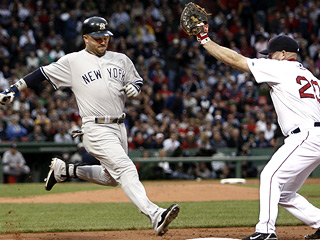 I couldn’t help but think of them watching the Yankees lose to the Sox Wednesday night. Take the top of the second, for instance. Matsui doubles and Swisher lays down a surprise bunt for a base hit, and then it’s first and third with nobody out. But then Melky Cabrera hits a hard shot to short, and Swisher’s strayed too far from the bag, and he gets easily doubled off. It would take a Jeter fly ball out to officially end the rally, but it really died with Swisher’s slipup. And he would further undermine the Yankees’ cause in the bottom of the inning misplaying what should have been a fly ball out to hand the Sox a run and compound Chien-Ming Wang’s struggles.
Give Swisher credit. He’d make a great catch later in the game. And he’d even hurl himself into the stands to try and make another. But in the end, it was the bad little things he did that hurt him.
We’ve seen lots of those things this series, and, so far, this whole season between the Yankees and Red Sox. It’s just like Sox players used to do, especially at Yankee Stadium. Except now the shoe — or maybe I should say the cleat — is on the other foot.
Now the point of all this isn’t to make everyone in Yankeeland feel more miserable than they already are. It’s to emphasize that baseball, more than any other sport, is one in which paying attention to details matter. The little things are what win or lose baseball games. Right now, when they play the Red Sox, the Yankees are doing all the bad little things, and that’s why they’re down 7-0 in the season series.
Here’s something to consider, though.
As I mentioned before, Ortiz’s Buckneresque play, and the Great Jeter Dive Game that capped the Yankee sweep of the Sox in July, all came in 2004.
That October, as nobody should have to be reminded, the Sox would turn the tables in historic fashion. Fortunes can change very quickly in baseball. And the players can make their own fortune.
Crestfallen Yankee fans might want to keep that mind as they drag through Thursday morning and afternoon, hoping for CC Sabathia to take the mound and prevent a sweep.
As might Red Sox fans amid their present good cheer.
Playing not to lose
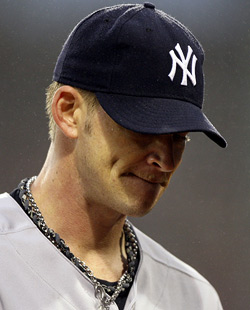 A.J. Burnett isn’t the only one to blame. Some of it falls on the Yankees’ absent offense and defense, and some of it’s about giving credit to Josh Beckett and the Boston Red Sox.
But Tuesday night’s loss at Fenway was mostly about Burnett’s haplessness on the mound. He couldn’t throw a fastball for strikes, and he couldn’t throw a curveball for strikes, and since those are his two primary pitches, it follows that he couldn’t throw much of anything for strikes. Less than three innings and eighty-four pitches after taking the mound, Burnett had surrendered five runs, two of which came on a loud David Ortiz homer to deep center. Loud when it happened, loud when it drew a curtain call from the Fenway crowd.
It was only his third home run of the season. Nobody has to be told it wasn’t the Big Papi Yankees fans have come to fear standing there at the plate. This was an Ortiz who hasn’t been Big Papi all season. An Ortiz who’s been getting far more catcalls than curtain calls at his home ballpark. An Ortiz whose batting average has barely scratched .200, who’s hitting .188 against righties, who was dropped from third to sixth in the batting order, who’s been benched in several series, and who Peter Gammons and others have reported has come close getting acquainted with the bench for a lot longer.
But there he went and did it, hitting one out against the Yankees for old times’ sake, laying into a four-seam fastball Burnett served right over the middle of the plate at 95 mph, right over, which only means that ball wanted to introduce itself to the sweet spot of his bat in a hurry.
Burnett wouldn’t be helped that inning by a fielding error committed by Alex Rodriguez, his fourth of the season. With one out, and outfielder Mark Kotsay having strolled to first after taking four consecutive fastballs that never came close hitting the plate, Red Sox shortstop Nick Green hit a hard grounder to third, and A-Rod seemed caught between going the easy out at first or a double play he wouldn’t have gotten anyway, and held onto the ball too long in his indecision. And then neither Green nor Kotsay were out, and couple of batters later both of them scored on a double.
Four-zip Sox. Second inning. You get them going at Fenway Park, you stake Beckett to that kind of early lead, and you are in serious trouble.
Again, the Yankees defense was complicit in the loss. There was Jorge Posada’s passed ball, and Robinson Cano missing a groundball to second that was ruled a hit but was a play he should have made.
The Yankees play eighteen errorless games, set a Major League record, and now all of a sudden they can’t go a single game without making one. Go figure. At Fenway, you can’t afford that. It helps lose games. Far less importantly, it forces out-of-market fans watching those games on NESN, the television home of the Red Sox, to hear their fill-in color commentator, resident baseball whiz and king of objectivity Dennis Eckersley, try to sell the argument that a record-breaking errorless streaks doesn’t mean a team’s played good defense during that streak.
Again, go figure.
But the big thing is the loss. This one, most of it, the sixth Yankees loss to their archrivals in as many games this season, falls on Burnett. He began poorly and never got himself straightened out, which is a mystery. This is not some inexperienced rookie pitcher we’re talking about. This is a 10-year veteran. Somebody who never used to lose against the Red Sox and killed the Yankees on his way to winning 18 games with Toronto last season. This is someone the Yankees signed for five years at $82 million to be their No. 2 starting pitcher. And he couldn’t adjust.
Can we throw in one last “go figure?”
In his postgame comments, manager Joe Girardi attributed Burnett’s wildness to too much rest. He hadn’t pitched in seven days as a result of Girardi’s decision to reinsert Chien-Ming Wang into the Yankees’ rotation, and then a rainout last Friday.
“It was control, and I’ll take the blame for that. I mean, it’s hard to pitch on seven days,” Girardi said. “A guy’s used to a routine, and we tried to change our rotation a little bit to separate some people, and insert Chien-Ming Wang, and you can’t have too many expectations of a guy’s command.”
But Girardi was skirting around the widespread perception that he’d largely changed the rotation to avoid leading off the series with Wang, who’s still working back into form, on the mound. Putting it another way, he thought Burnett had a better chance of getting things off to a solid start for the Yanks.
His explanation for Burnett’s lack of command is also based on suspect logic. Monday night at Yankee Stadium, Phil Hughes had no trouble throwing quality strikes for a scoreless seventh-inning after cooling his heels in the bullpen for well over a week. Last Thursday, Wang managed to throw a decent ratio of strikes-to-balls in his first start since returning from rehab. If they weren’t too strong, why was Burnett?
After the game, YES studio analyst David Cone commented that the good pitchers, the really good ones, are supposed to be able to make the adjustments. He ought to know. He once ranked among the best.
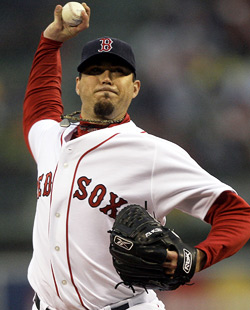 And let’s add Beckett to the list. As Johnny Damon would point out, he’d also labored through the early innings, struggling with an inability to locate his off-speed pitches. But, said Damon, Red Sox catcher Jason Varitek noticed that Beckett’s four-seamer was working best for him and repeatedly called for it until he could spot it over the plate — and then build off it until he got a feel his curveball.
The Burnett-Posada tandem could accomplish no such thing. And when interviewed in the visiting clubhouse, even Burnett wouldn’t let Girardi’s too-much-rest, too-strong, explanation take him off hook.
“There’s no excuses,” he said. “I mean, I was out of whack, and I don’t think I repeated a delivery the whole two innings I was out there. So that’s just, you know, Skip being Skip.”
Translated: That’s just the manager expressing confidence in his player and casting his poor performance in the best possible light.
Girardi trying to take some of the heat off him is commendable — but it won’t erase Burnett’s ineffectiveness, or change the fact that he’s only won four out of his 11 starts for the Yankees and is carrying a 4.89 ERA into June.
Whatever the reason, Burnett has underperformed to this point. At Fenway Tuesday night, he appeared to be pitching not to lose rather than pitching to win — and to a point that’s how his team appeared to be playing behind him
Six games against the Red Sox, six losses.
If the Yankees are going to win the AL East in 2009, that will have to change.
Tonight would be good time to start.
Neighborhood Plays: Saturday In New York
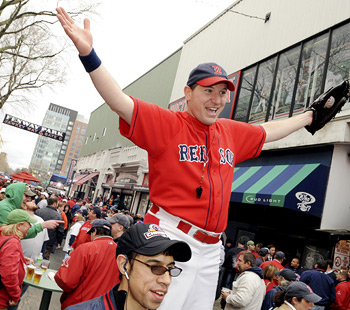 So it’s Saturday morning in New York, and we’re at the First Avenue Coffee Shop, this great little place where you can still grab breakfast for under five bucks, and that includes endless coffee refills and a glass of fresh-squeezed orange juice. It’s been in the neighborhood as long as I have, which is a long time, and I never checked it out till maybe a month ago, shame on me.
Anyway, I’m forking scrambled eggs and home fries into my mouth when I overhear Suzy, the waitress of waitresses who seems to run the joint, talking to another customer over at the counter.
” … and all of a sudden, they don’t want to talk Yankees-Red Sox!” she says.
My writer-in-search-of-material receptors whipping up into the air like I’m some kind of bug, I look across my table at The Wife, who’s quietly snoopier than I am.
“You happen to hear who she means by ‘they’?” I ask.
“Red Sox fans,” she replies, chewing her muffin. There you go — didn’t I just say The Wife was a major snoop? “She was telling the guy that they don’t want to talk Yankees-Red Sox anymore now that the Yanks are in first place.”
I swivel around in my chair to look at Suzy.
“You a Yankee or Red Sox fan?” I ask, dutifully checking The Wife’s facts.
“A Yankee fan!” Suzy says, and eyes me suspiciously. She seems vaguely upset by the mere suggestion that she could be anything else. “You a Yankee fan?”
“I write a column for the YES Web site,” I say.
“Great,” she says. “What’s your name?”
I tell her. She promises that she’ll check me out online, brings the coffee pot over to our table, freshens up our cups, and formally introduces herself.
“We heard you talking … ” I begin.
“Red Sox fans come in here, they catch it from me,” Suzy says before I finish my sentence. “They think they can walk around New York with their caps, I let them have it.”
I look at her. It’s nine o’clock on a weekend morning, and the place is already jumping. People from every cultural background and financial status under the sun are mingling at the counter like they’ve known each other all their lives, like they’re best friends or family at some kind of reunion, with Suzy here being the queen of all things breakfast-wise and master of ceremonies rolled into one.
And then it hits me that the only people she won’t tolerate in this New York melting pot of a coffee shop are Red Sox fans. Perfect.
“Pleased to meet you,” I say, slyly shaking her hand.
Slyly because I know I’ll be doing a whole lot of hanging out at the coffee shop from now on. And that you’ll be hearing plenty about it.
_______________________
“Did you just say you were going to the Yankee game today?” asks the woman at the table across from us.
This is maybe 10 seconds after Suzy’s headed back around the front counter. We’ve seen the woman here before, reading the New York Times while eating cereal and cantaloupe and stuff between sips of coffee.
“No,” I answer. “I was just mentioning that I write this column about the Yankees … “
“Oh,” the woman says. “You know, my son and his friends bought Yankee tickets from a scalper a couple of weeks ago and they turned out to be counterfeit.”
“Ouch,” I say, shaking my head. “That stinks.”
“They were really looking forward to the game,” she says.
“I bet.”
“It was Bat Day.”
“Adding insult to injury,” I say. “Next time maybe he’d better go through StubHub if it’s at the last minute.”
She asks me what StubHub is and I explain.
“The kid grew up in the city,” she says after thanking me for the skinny. “You think he’d know better than to get ripped-off by a scalper.”
“Hey, no shame. I grew up in Brooklyn and got ripped-off lots of times,” I say.
I’m suddenly remembering when I got scammed out of a full week’s minimum-wage record-schlepper’s pay while trying to help some guy who claimed to be a lost Jamaican sailor. And remembering when I was walking toward the F-train subway entrance on 42nd Street at one or two in the morning, and a bunch muggers with knives swarmed me out of nowhere, and I made a break for it and bolted downs into the station with all of them on my heels, and got lucky enough to run smack dab into a cop with a German shepherd at the bottom of the stairs.
I’m remembering those misadventures, and a couple of others too, and secretly thinking that, for every time I got robbed or suckered, at least I never had a lousy ticket scalper make a fool out of me outside Yankee Stadium.
And then it occurs to me that only in New York City can one person feel he’s got something over another person because he was ripped-off in a way that’s less embarrassing, relatively speaking, at least in his own mind.
In Maine, when people talk about getting ripped off, they’re making price comparisons between the local supermarket and Wal-Mart.
_______________________
“Too bad our game was washout, huh?” says the guy with the corner fruit and vegetable stand.
Done with breakfast, The Wife and I have just passed his stand on the way back to our apartment when I hear that snipped of conversation.
I glance over my shoulder and notice the produce man’s talking to an older guy who’s stopped to check out his goods.
“Yeah,” says his customer. “Ruined my whole night.”
“Well, today’s sunny!” says the fruit man. “No more rain!”
The customer holds his palm out as if to confirm it, then nods his head.
“Yeah, you’re right,” he says. “It’s beautiful.”
“What are you going to do in this beautiful weather?”
The customer gives the fruit man a look that implies he has to be kidding.
“What else?” he says. “Stay home and watch the Yankees on TV.”
Which I’m thinking is about the closest many New Yorkers get to outdoor activity when the Yankees play a day game … and happens to be exactly what I plan on doing on that gorgeous June day.
 Deep in the Red