Category: Dailies
Mo on the mend?
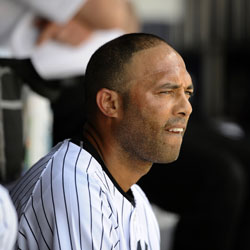 In the wet, chilly first week of May, the Tampa Bay Rays swept a brief series at Yankee Stadium that had been shortened from three games to two due to rain. Both were tough losses for the Yanks, coming after they’d fought their way to late game-tying rallies.
On May 7, with the Yanks trailing 3-0 at the bottom of the eighth, Mark Teixeira hit a bases-clearing double to knot the score at 3-3 and force extra innings. But after pitching a scoreless ninth, Mariano Rivera was replaced in the tenth inning by lefty reliever Phil Coke, who surrendered what proved to be the game winning home run to Rays’ firstbaseman Carlos Pena.
At the time I’d written a column asking a question on the minds of many Yank fans: Why hadn’t Rivera, whose workload had been light that week, remained on the mound for a second inning of relief?
I would get my answer the next night following yet another bitter defeat for the Yanks — one that was especially shocking because of the future Hall of Fame closer’s role in giving Tampa a decisive lead.
For the second game in a row, the team had come back twice from an early four-run deficit to even things up at the bottom of the eighth. Called on to preserve the tie at the top of the ninth, however, Carl Crawford and Evan Longoria tagged Rivera for back-to-back home runs. It was the first time in his career that happened.
Crawford hit the first after Rivera shot him a steady stream of cutters with one four-seam fastball mixed in. All were in the 89-91 mph range. The ninth pitch, a 91 mph cutter, left the park in right field.
Longoria’s homer came after five pitches. The first four were 90-91 mph cutters. The fifth was an 89 mph four — seam fastball that Longoria smashed into the left field stands with a sound like a thunderclap.
Answering questions from the press hat day, manager Joe Girardi admitted that Rivera, who’d had offseason surgery to eliminate calcification — or a bone spur — in his right shoulder, had experienced some days “where he hasn’t felt the greatest.”
“The velocity is not there,” he’d said of Rivera’s cut fastball, which has in recent seasons typically registered at 93-94mph. “That’s part of it. I still think he’s coming back from the surgery he went through. That’s why we’ve been very careful with him.”
The cutter is of course Rivera’s trademark pitch, the key bullet in his arsenal, its velocity and movement running it sharply in on right-handed batters and away from lefties.
But what happens when some of that speed drops off?
The question remained in the background for almost a full month after Rivera was stunningly bested by the pair of Tampa hitters. Although he’d given up more hits than Yankee fans were accustomed to seeing in that period — and allowed home run in a rocky save against the Baltimore Orioles on May 20 — his strikeout rate was high and most innings thrown scoreless. Overall for the season, he was 12-for-13 in save opportunities going into Saturday’s game — the first in another rain-shortened series between the Yanks the Rays in the Bronx.
But, almost exactly a month after Rivera was stunningly beaten by Crawford and Longoria, bad history seemed to come around and bite him again. The game was uncannily similar to the May 7 loss. The Yanks had twice rallied from deficits, beginning the second with a dramatic Teixeira home run in the eighth. The Yanks went into the inning trailing 5-3. When it ended the game was tied at 5-5.
Rivera entered in the ninth to preserve the tie. When he was pulled from the game after inducing only two outs, the score was 7-5 Rays. He had faced six Tampa batters and left a pair of men on base for his replacement, Phil Coke. Before that inning ended, Tampa would tack on another pair runs to make the score 9-5 and withstand another Yank surge to hang onto a 9-7 victory.
This is how Rivera’s 2/3 of an inning vs. the Rays breaks down:
1) He threw five 90-92 mph cutters to shortstop Ben Zobrist. The fifth was hit out to left field for a triple.
2) He threw two four-seamers to Joe Dillon, one at 92 mph, the second at 93 mph. His third pitch, a 93 mph cutter was singled out to center.
3) He elicited a soft groundout from Dioner Navarro with three 91 mph pitches, a four-seam fastball followed by two cutters.
4) He threw Matt Joyce three cutters that ranged from 89-92 mph for what would appear on the box score as a flyball out — but that, in fact, might well have been an extra-base hit off the right field wall if not for an excellent running catch by Nick Swisher.
5) He issued an intentional walk to Evan Longoria to face outfielder B.J. Upton.
6) He threw three 92 mph cutters to Upton, the third of which was lined into centerfield for a single.
This brought Rivera’s disastrous outing to a close as he was removed from the game to watch the rest of the carnage — and as Yankee fans were left wondering whether this was just another rough spot along the way for the 39-year-old closer, or a sign that time was finally robbing him of his unparalleled effectiveness.
I think the answer probably falls somewhere in the middle. Rivera is the greatest reliever in the history of baseball. But he’s also human, vulnerable to the effects of aging — and recovering from shoulder surgery, as Girardi pointed out back in early May.
Yankee pitching coach Dave Eiland would likewise emphasize his return from surgery on Thursday, June 4, after Rivera notched his twelfth save of the season with a scoreless but dicey outing against the Texas Rangers in which he allowed a double to Michael Young and a single to Hank Blalock.
“The guy’s come off shoulder surgery,” he responded to a question about Rivera’s pitch speed, which that day had measured between 91-93 mph on the radar gun. “He’s never had to do that before. But if his velocity doesn’t ever go back up, he still has the command of his fastball — that late movement he has to both sides of the plate. He commands the baseball as good as anybody in the game, so for me his velocity is not a big deal. If it comes back, great. We think it will. But if it doesn’t, we’re still comfortable with what he can do where he’s at velocity-wise now.”
At his locker a few minutes later, I listened as Rivera himself assessed how he felt about the way he’s currently pitching with these words: “I’m okay. I’m okay?” he said. “I don’t have to ask for nothing better, you know what I mean? I’m gonna go there, I’m gonna give my best.”
When a reporter asked if he felt altogether back to himself after some rough early season outings, Rivera replied, “Well, I mean, I’m pitching, more, more. So, I have more opportunities. The longer you keep throwing on these occasions, everything is gonna be good.”
Never one to make excuses, Rivera was hardly unequivocal about his current physical condition. He is obviously aware he isn’t in top form.
So what’s next for him?
Rivera has for years reportedly thrown a changeup in Spring Training bullpen sessions, and he may have to expand his repertoire to occasionally include it in game situations, throwing hitters off-balance, and stopping them from waiting on his fastball when it lacks bite.
It’s also important that we remember he is made of flesh and blood that is still in the process of healing–and that we acknowledge the signs that his arm is getting stronger as the season progresses. Though not entirely back up to speed, his fastball has gained a mile or two from earlier in the season and is getting close to its optimum velocity. Also, as Eiland stressed, his comma
nd has been mostly superb.
There is certainly reason for concern, nevertheless. Rivera cannot go on eternally pitching at the level to which we’ve been accustomed. We have seen him get hit harder, and more often, this year than ever before. And will likely see more bumps in the road.
But even at the latter stages of his career, Rivera remains the best and most consistent closer in baseball.
I’d rather have him on the mound closing games for the Yankees than anyone. Bumps and all.
Plots, subplots and spirit pie
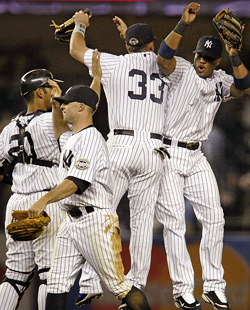 As someone who earns his bread and butter writing novels, I’m always seeking narrative threads to play with: the plots and subplots that drive a story forward and create its textures and dramatic tension. I generally know where I’m starting out and have a rough idea where I’m heading. But writing a book takes anywhere between six months to a year. That’s a long time to live with characters on a daily basis. As they move within a set of circumstances I’ve thrust on them, they inevitably evolve and do things that surprise me … or do them in surprising ways.
It’s these twists and turns that make a story interesting for me — and hopefully for my readers — even as it moves toward the general resolution I’ve envisioned.
A baseball season’s a lot the same in my eyes. At one end there’s Opening Day, at the other the final pitch of the World Series. But between those fixed points lie constant, fascinating nuances and surprises. Which teams make it to the finish line? Which individual players? How do they get there? What happens to them along the way, and leaves some standing and others casualties of war?
There’s something about baseball that’s more richly textured than any other sport. Something about its pace — nine innings a game, 162 games played out over six long months, the give and tug within and between teams over that period — that heightens a season’s tension as it progresses and gives each one an epic quality. I think it’s no coincidence that most writers I know who are sports fans tend to love baseball above all others. The storylines always fascinating and unpredictable.
I started out for Yankee Stadium Thursday morning meaning to examine Chien-Ming Wang’s reinsertion into the Yankees’ starting rotation and its impact on Phil Hughes, the pitcher whose slot Wang was taking. But the three-hour match between the Yankees and Texas Rangers became a humming tapestry loaded with intriguing, interactive plot threads. Here are my thoughts on several of them, starting with the one I’d meant to write about in the first place.
WANG/HUGHES
The moment Joba Chamberlain took Adam Jones’ hard line drive to his knee on May 21, the seasons of Wang and Hughes irreversibly changed. Wang was headed for Pawtucket where he’d been scheduled to complete an extended rehab assignment when he was ordered to turn around and head back to New York. With Chamberlain’s ability to make his next start in question, the Yanks wanted an insurance policy — and Wang became just that.
It turned out that Chamberlain was able to take his normal turn on the mound. It also turned out that the Hughes, long the gem of the Yankees’ farm system, was pitching well with consistency for the first time in his brief Major League career. With Wang out of options, the Yankees could not send him down to the Minor Leagues without placing him on waivers and giving every team in baseball the chance to acquire him.
Wang consequently went into the bullpen with an indeterminate long-relief role that left his progress stalled. He would need repetitions — regular work, in other words — to sharpen his delivery and rebuild his stamina and confidence. But he wasn’t going to get that doing irregular mop-up duty.
The Yankees did not have a plan, or so it seemed for a while. But five increasingly strong innings of work from Wang out of the ‘pen apparently compelled them to formulate one.
And so the announcement was made less than 24 hours before Thursday’s game. Wang would start in place of the scheduled CC Sabathia and Hughes would be moved to the bullpen.
In his pregame press conference Thursday morning, manager Joe Girardi said this of their decision on Wang:
“He’s won 46 games in two-and-a-half years. I’m not sure how many guys in our clubhouse can boast that. So, I mean, this is not just a guy that we’re trying out. This is a guy we believe in, and {who} has been the ace of the staff here for the last three or four years. “
As has been previously discussed in this column, Wang is also a precious commodity in the new home run-friendly Yankee Stadium — a power sinkerballer who, at his best, can elicit groundballs and strikeouts to combine for a very high rate of efficiency. Besides racking up outs, that efficiency has a fringe benefit of getting him deep into games. In 2006, his first full season in the Majors, he ranked fifth overall in the number of innings pitched (218) in the American League, falling between Roy Halladay and John Lackey. The next year he fell to 21st (199 innings) but was still in the upper percentile of AL pitchers and only two spots behind Josh Beckett.
In fact, Wang’s 2007 drop off in ranking was due more to other pitchers having above-par years than Wang having a below average one. Before Wang’s 2008 season abruptly ended by a Lisfranc injury in mid-June, he was off to a tremendous start, having thrown 95 innings and racked up 54 strikeouts to go 8-2 in the win-loss columns.
As Girardi implied, Hughes, for all the growth he’s shown of late, has achieved nothing close to that success in his young career. Wang has not only earned his chance at a return to the starting rotation, but was in danger of losing arm strength and regressing in the bullpen. This is best for Wang and — in the short term — likely best for the ballclub. So, for now, the rotation is where he’ll be. And it is Hughes to the bullpen … and perhaps to the Minor Leagues upon reliever Brian Bruney’s eventual return from the disabled list.
But it’s an imperfect solution.
“I see using him in any role,” Girardi said of Hughes. “Some distance, maybe. Seventh and eighth, maybe. I could use him for one inning … He could be used at any time.”
Girardi also emphasized that the ballclub considers Hughes its “sixth starter” – a pitcher who can instantly be inserted into the starting rotation should one of its regulars become injured. The drawback of an extended bullpen stay for Hughes, however, is identical to the situation Wang was facing. It would diminish his stamina and make a quick jump back into a starter role difficult.
This is why Yankees GM Brian Cashman suggested on the ESPN radio Wednesday that Hughes might be sent down to Scranton if Bruney comes back to the club healthy. This reasoning is understandable and arguably sound. But while maintaining physical durability, will a return to Triple-A retard Hughes’s mental progress? There’s something that seems to have clicked with him besides more consistent command of his pitching arsenal — and that’s the ability to out-think veteran Major League hitters with his pitch selection. Hughes has advanced far beyond the level of skill need to get out Minor Leaguers. He has broken a barrier that impeded his success for the entire 2008 season. Will returning him to a setting where he’s faces inferior competition turn cause him to lose the edge he’s finally, and so recently, developed?
It remains to be seen. With six legitimate starting pitchers for five spots in their rotation, the Yankees are dealing with the “good problem” of baseball cliché.
Still a problem is a problem.
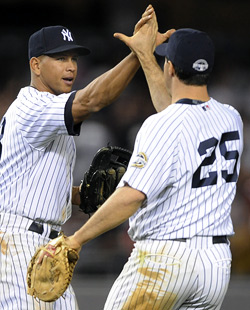 TEIXEIRA/A-ROD
In the fifth inning, with the Yankees trailing by three runs, Mark Teixeira hit a double to clear the bases and tie the game at 5, sparking the team’s 19th comeback win of the season. The hit was hardly a blast off his bat, but looked more
like a shot off a pool cue as the ball bounced over third base, hugged the left field line and went rolling on into the outfield as three Yankees runners darted home to score.
“That’s for all the times you hit a ball to the warning track or a line drive right at somebody,” Teixeira said afterward with a grin.
Watching that game-changing play from the press box, it struck me that Teixeira has taken New York by storm with his glove and bat. He seems to do everything right when it counts the most. Two days before, after getting drilled by Rangers pitcher Vicente Padilla, he sparked a lethargic Yankee offense that was trailing 3-2 to a now-celebrated seven-run rally by breaking up a double play with a hard, clean slide into second base. Showing a grit and fire that’s perceived as having been lacking in recent Yankee teams, Teixeira drew well-deserved roars from the stands. He not only took a large step toward defining his identity in pinstripes, but also the spirit of the current group of Bronx Bombers.
It’s more than a slightly interesting footnote that the batter who started the potential double play with a groundout to second base was Alex Rodriguez, who’d been having a terrible series. Rodriguez had not only been striking out, flying out, and hitting into DPs left and right, but he’d been doing it at the worst of times, killing rallies by the bunch rather than starting them.
After Thursday’s game, a longtime clubhouse insider lamented that fans who’d jumped back on the Let’s-Boo-Alex bandwagon weren’t recognizing that his return to the lineup — and specifically his presence behind Teixeira in the lineup — following hip surgery and a hurried rehab are a large part of the reason Teixeira is getting better pitches to hit these days. And that the team’s streaking to the best record in the American League after a depressing start coincided with Rodriguez’s activation from the disabled list.
I disagree with that insider. I think the boo-birds are fully aware of Rodriguez’s importance to the team. I think they realize the Yanks were floundering before he returned, and I think they would gag and clutch their chests if he were to suddenly reinjure himself, opening up third base for the platoon of Angel Berroa, Ramiro Pena and perhaps eventually a healed Cody Ransom.
Because of his salary, and because of his occasional forays from the sports to the gossip pages, A-Rod is simply an easy target of frustrations when things go wrong for the team, and sometimes, maybe, when those anonymously jeering him have had a bad day at work.
I’m glad Teixeira has been welcomed to the Bronx for doing things right. Too bad people won’t get off Rodriguez’s back — and be as appreciative of him as Teixeira has vocally and visibly been in the Yankees dugout and clubhouse.
 MELKY AND THE SPIRITS
After his game winning two-run homer in the eighth inning, Melky Cabrera — who’s gotten more big late-game and walkoff hits than I can count this season and is hitting .483 in close and late game situations — managed to duck an A.J. Burnett pie while being interviewed for the Yankees radio postgame show by Suzyn Waldman.
I’d lingered in the press box to see whether or not a pie would be introduced to Melky’s face, having debated my colleague Jon Lane on whether eighth inning hits were pie-worthy as opposed to walk-offs exclusively. Jon didn’t think so. I did. I won, and hustled down to the Yank clubhouse to boast.
A while after the whipped cream flew, I was standing in front of Cabrera’s locker when a member of the press jokingly asked if he felt he’d become a home run hitter like A-Rod or Teixeira. Smiling, Cabrera modestly replied through his translator, Yankees team adviser Ray Negron, that he was a line drive hitter just looking to put the ball in play.
The reporter followed through by asking how the ball managed to get out of the park the way it did.
Cabrera simply shrugged.
“It’s the spirits,” he said in all earnestness.
Before heading into the elevator up to the press box, and then again inside it , one reporter found Cabrera’s remark amusing enough to launch into what he presumably thought was a derisive comedic routine about it.
“Did you hear what he said? The spirits! Why not the jet stream!” he mocked.
A few occupants of the crowded car chuckled with him. I didn’t. Nor did I bother reminding the reporter — whom I’ve never seen hit a home run — that the jet stream doesn’t blow out to deep left field, where the home run ball landed. Cabrera has been nothing less than magical for his team — a magic for which his commitment and hard work have opened the door.
If he says it’s the spirits, it’s the spirits.
Radio Babe
 So we’re at our place in Maine the other day, and the Wife comes home,
walks into my office, and says, “I just talked to a guy who met Babe
Ruth.”
I turn from my computer monitor, a leery expression on my face.
“And Joe D., I bet,” I say.
She frowns. “Actually he saw DiMaggio play the outfield in
Yankee Stadium and described how he never dove to catch a ball, but
always seemed to glide on under it. Now do you want to listen or
shouldn’t I bother?”
You can guess what I do, being good at self-preservation. Lucky
thing I pay attention, too, because it’s a little gem of an anecdote.
Let me set it up for you: The Wife has a loose group of
sports-fan friends and acquaintances in the area, and she often runs
into them when she leaves the house — a rarity for me except when I’m
going to baseball games. Many of these people have lived awhile.
Conrad, for instance, is a World War II veteran and Yankee fan. Last
year, I think around Christmastime, he gave us a beautiful, customized
New York Yankees baseball bat as a gift. He’d made it in his workshop,
I guess.
Then there’s another guy, Dil, which just might be short for
Dillard. He mostly loves football. A major New York Giants fan, he
wears his Big Blue gear summer and winter. Over a year after the Giants
won the Super Bowl, he’s still sticking it to his Pats buddies around
here
So, The Wife’s talking baseball with these two, and maybe another member of her crew, when another
guy overhears them moseys up to join the powwow. Turns out he’s another
lifelong football Giants fan, born and raised in New York. As a kid, he
was also a Yankees fan, but flipped — shudder — to rooting for the Red
Sox sometime after moving to New England. His loyalty to the Giants
hasn’t wavered, however. For some reason, he claims Giants fan
allegiances are unassailable.
Anyway, it’s this guy, whose name I promise I’ll get you in the near future, that tells the Ruth story.
It seems that back in the 1930s and ’40s, The Babe hosted, or co-hosted
several radio programs. One was a short-lived CBS show called Here’s Babe Ruth. Another was called Baseball Quiz.
It had several runs on the NBC radio network between 1943 and 1944, and
aired on Saturdays in front of a live studio audience.
Here’s where The Wife’s new friend comes in.
One weekend when he was a kid, the guy’s dad took him and his brother to see The Babe do his Baseball Quiz show,
which he remembers as having been broadcast out of New Jersey — likely
it was WJZ in downtown Newark, the second station in the country to be
licensed for radio, and a pioneer in baseball programming. The Babe had
a regular segment for audience questions at the end of the show, and
the boys had spent a lot of time brainstorming one in advance, in case
they were lucky enough to be chosen.
When the Wife’s friend got picked, he was keyed up with excitement.
“If you were putting together an All-Star team, what players would you have on it?” he asked, proud he’d been ready.
The Babe looked at him a moment from behind his microphone.
“Kid,” he boomed with a huge grin, “that’s too big a question for me this late in the day!”
All these years later, the guy remembers it as a perfect Ruthian moment.
He’s got plenty of other firsthand baseball memories from the old days,
like that vivid recollection of DiMaggio gliding across the outfield.
And, get this — he told The Wife he didn’t think anybody would be
interested in them.
Wrong.
I’m going to have breakfast with him soon and get you some more of his stories.
Not to mention his name.
Comments? Questions? We invite you to send your feedback on Deep in the Red to readermail@jeromepreisler.com.
 Deep in the Red